|
|
The Crimean War 1854-1856
The Crimean War has remained in the national consciousness due mainly to the infamous Charge of the Light Brigade. However, despite the war's many failings, several far-reaching innovations came out of the conflict.
The war was sparked by a Franco-Russian dispute over the Christian holy places in Ottoman-occupied Palestine. The British, French and Turks responded to Russian aggression by sending an expedition to the Crimea to eliminate the Black Sea naval base at Sevastopol. Victory at the Battle of the Alma enabled the Allies to besiege Sevastopol, but the Russian counter-offensive prevented Sevastopol's capture before the onset of the harsh Crimean winter. It became apparent that the British supply system could not cope: soldiers died in their thousands from fatigue, exposure and disease.
The British public, alerted to the disaster by the world's first true war correspondents, endorsed an outcry in the newspapers sufficient to bring down the government. Commissions of inquiry began to investigate Britain's archaic military bureaucracy and reforms in hospital hygiene were advanced. After year-long siege, Sevastopol fell; but in victory there were lessons to be learned.
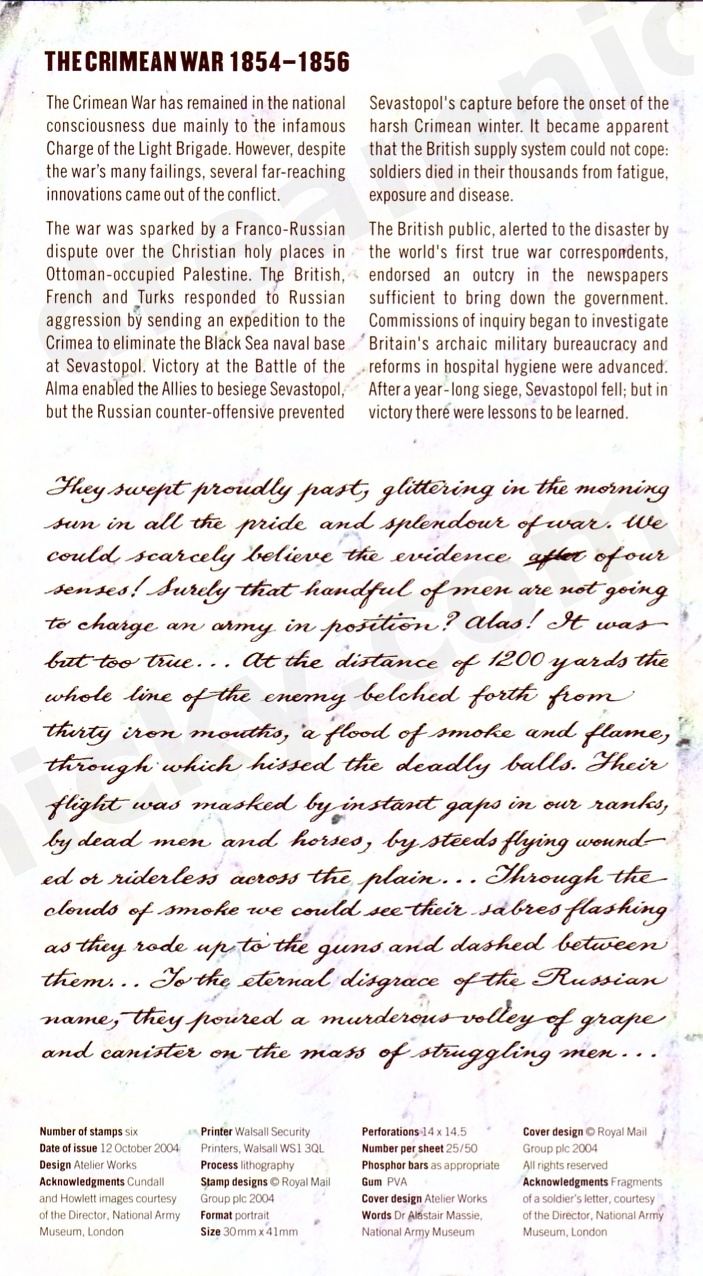
They swept proudly past, glittering in the morning sun in all the pride and splendour of war. We could scarcely believe the evidence after of our senses! Surely that handful of men are not going to charge an army in position? Alas! It was but too true... At the distance of 1200 yards the whole line of the enemy belched forth from thirty iron months, a flood of smoke and flame, through which hissed the deadly balls. Their flight was masked by instant gaps in our ranks, by dead men and horses, by steeds flying wounded or riderless across the plain... Through the clouds of smoke we could see their sabres flashing as they rode up to the guns and dashed between them... To the eternal disgrace of the Russian name, they poured a murderous volley of grape and canister on the mass of struggling men...
|
Technical Details
Number of stamps: six
Date of issue: 12 October 2004
Design: Atelier Works
Acknowledgements: Cundall and Howlett images courtesy of the Director, National Army Museum, London
Printer: Walsall Security Printers, Walsall WS1 3QL
Process: lithography
Stamp designs © Royal Mail Group plc 2004
Format: portrait
Size: 30mm × 41mm
Perforations: 14 × 14.5
Number per sheet: 25/50
Phosphor bars: as appropriate
Gum: PVA
Cover design: Atelier Works
Words: Dr Alastair Massie, National Army Museum
Cover design © Royal Mail Group plc 2004
All rights reserved
Acknowledgements: Fragments of a soldier's letter, courtesy of the Director, National Army Museum, London
Search this site for first day covers:
|


 United Kingdom
 Back to Page 8
 Jump
Jump