|
|
The Wilding Definitives Collection II: 1953-1959
An advisory panel to assist the Post Office in preparing the new definitive stamps was established early on in 1952. Among the members of this panel were Edmund Dulac and Sir George Bellew of the College of Arms. Artists and stamp printers were instructed to provide designs in vertical format, and include the words 'postage' and 'revenue'.
A deadline of 30 June was set and during July the panel considered a total of 75 designs. This was reduced first to 19 and then to a shortlist of nine and presented to Her Majesty. With minor modifications a final five designs were approved. The Postmaster General suggested that the first five values be in each of the chosen designs, and repeated in twos or threes throughout the range. An alternative was ½d-2d, 2½d-4d, 5d-8d and 9d-1s. In October, higher values (ls3d and 1s6d) were agreed to cover increased overseas postal rates.
The first two values were issued on 5 December 1952, covering basic postal rates with further values issued throughout 1953. Achieving satisfactory colours sometimes proved difficult such as for the 4d, 1s6d and 1s3d, issued on 2 November. The latter stamp was essayed in shades including Winstone bottle Vert, Nickel, Blue, Jade and Spectrum green before a simple green was selected. The 1s6d was printed in steel blue which matched exactly the corresponding value in the Coronation stamps set of 3 June.
Although the 3d, 6d, 7d, 9d, 10d and 11d were to be printed in identical colours to the George VI issue, there was a degree of 'nit-picking' over shades. The 3d, 6d and 7d were issued on 18 January 1954, followed by the 9d, 10d and 11d on 8 February. Two years and two days after the accession, the Queen Elizabeth low-value definitive stamps series was finally complete. There were further modest changes to the colours of the 2d, 6d and 4d stamps in 1956, 1958 and 1965 and a 4½d value was added on 9 February 1959.
The Wildings were replaced by a new series, the 'Machins', from June 1967, although they remained valid for postage until 29 February 1972. The series is a complicated one with different watermarks, papers and varieties, but remains hugely popular among its devotees.
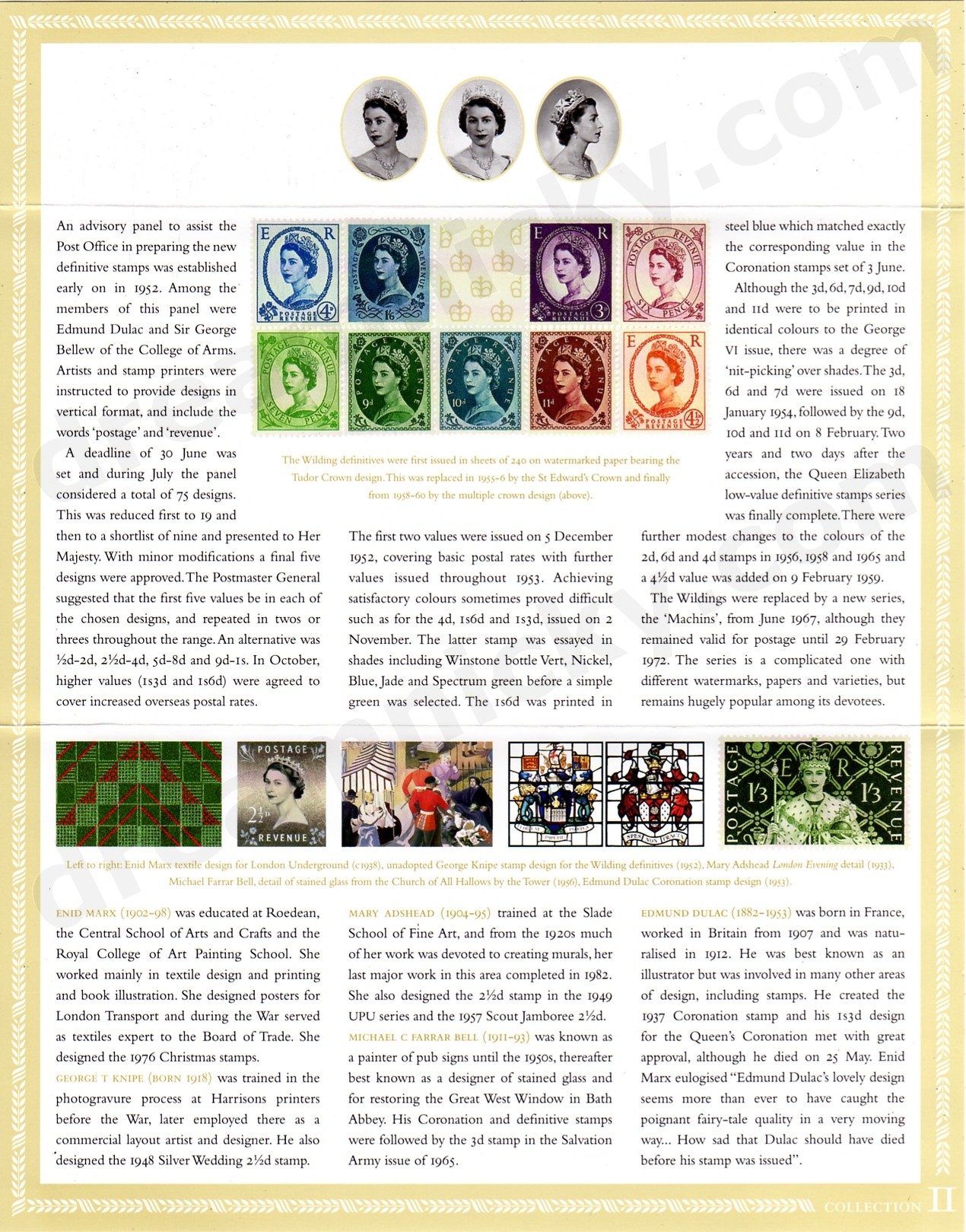
The Wilding definitives were first issued in sheets of 240 on watermarked paper bearing the Tudor Crown design. This was replaced in 1955-6 by the St Edward's Crown and finally from 1958-60 by the multiple crown design (above).
Left to right: Enid Marx textile design for London Underground (c 1938), unadopted George Knipe stamp design for the Wilding definitives (1952), Mary Adshead London Evening detail (1933). Michael Farrar Bell, detail of stained glass from the Church of All Hallows by the Tower (1956), Edmund Dulac Coronation stamp design (1953).
ENID MARX (1902-98) was educated at Roedean, the Central School of Arts and Crafts and the Royal College of Art Painting School. She worked mainly in textile design and printing and book illustration. She designed posters for London Transport and during the War served as textiles expert to the Board of Trade. She designed the 1976 Christmas stamps.
GEORGE T KNIPE (BORN 1918) was trained in the photogravure process at Harrisons printers before the War, later employed there as a commercial layout artist and designer. He also designed the 1948 Silver Wedding 2½d stamp.
MARY ADSHEAD (1904-95) trained at the Slade School of Fine Art, and from the 1920s much of her work was devoted to creating murals, her last major work in this area completed in 1982. She also designed the 2½d stamp in the 1949 UPU series and the 1957 Scout Jamboree 2½d.
MICHAEL G FARRAR BELL (1911-93) was known as a painter of pub signs until the 1950s, thereafter best known as a designer of stained glass and for restoring the Great West Window in Bath Abbey. His Coronation and definitive stamps were followed by the 3d stamp in the Salvation Army issue of 1965.
EDMUND DULAC (1882-1953) was born in France, worked in Britain from 1907 and was naturalised in 1912. He was best known as an illustrator but was involved in many other areas of design, including stamps. He created the 1937 Coronation stamp and his 1s3d design for the Queen's Coronation met with great approval, although he died on 25 May. Enid Marx eulogised "Edmund Dulac's lovely design seems more than ever to have caught the poignant fairy-tale quality in a very moving way... How sad that Dulac should have died before his stamp was issued".
|
Technical Details
THE WILDING DEFINITIVES COLLECTION II
Date of issue: 20 May 2003
Miniature sheet design by Rose Design
Type rendering by Mike Pratley
The stamps were printed in gravure on watermarked paper by De La Rue Security Print, UK
STAMP DESIGNS
MC Farrar Bell (4d, 3d, 4½d)
Edmund Dulac (1s6d)
George Knipe (6d, 7d)
Mary Adshead (9d, 10d, 11d)
Stamp designs © Royal Mail Group plc
The Wilding Collection I was issued on 5 December 2002 and featured reproductions of the first nine Wilding definitives, including four bearing the Enid Marx design.
PACK NUMBER: 61
The pack was designed by John and Orna Designs, London and written by Giles Allen and John Holman.
Pack printed by Perivan White Dove, UK.
ACKNOWLEDGEMENTS
Flap image: portrait from April sitting © Royal Mail Group plc. Front panel: Dulac image © unknown. Inside/top: portraits from April sitting © courtesy of Tom Hustler/National Portrait Gallery, London (all images show details from the original photographs). Bottom/left to right: Marx © Transport for London; Knipe © Royal Mail Group plc; Adshead © Bone Family Archive; Farrar Bell © All Hallows by the Tower; Dulac © Royal Mail Group plc
Pack design © Royal Mail Group plc 2003.
All rights reserved.
Search this site for first day covers:
|


 United Kingdom
 Back to Page 6
 Jump
Jump