|
|
Pillar to Post
A much loved and quintessential feature of the British street scene, the pillar box celebrates its 150th anniversary in 2002.
The British letter box resulted from the 1840 Postal Reform, which introduced a universal, affordable postage rate. This was easily prepayable by means of the new adhesive stamps; but letters still had to be taken to the nearest letter receiving office, often miles away. In turn, this led to a need for more places, closer to hand, where letters could be posted. The novelist Anthony Trollope (then a postal official) provided the solution: adoption of the Continental system.
Cast-iron pillars were to be placed at the roadside, with regular times of collection. His scheme began in the Channel Islands in 1852, and was extended to the mainland in 1853.
In this 150th anniversary year of Britain's first pillar boxes, Royal Mail is proud of the fact that some of its earliest examples remain in service. The oldest pillar box in daily use on the mainland is at Bishop's Caundle in Dorset. Royal Mail is committed to a policy of preserving all its letter boxes, irrespective of their age, for as long as possible, in their existing locations, so they might continue to serve their community well into the 21st century.
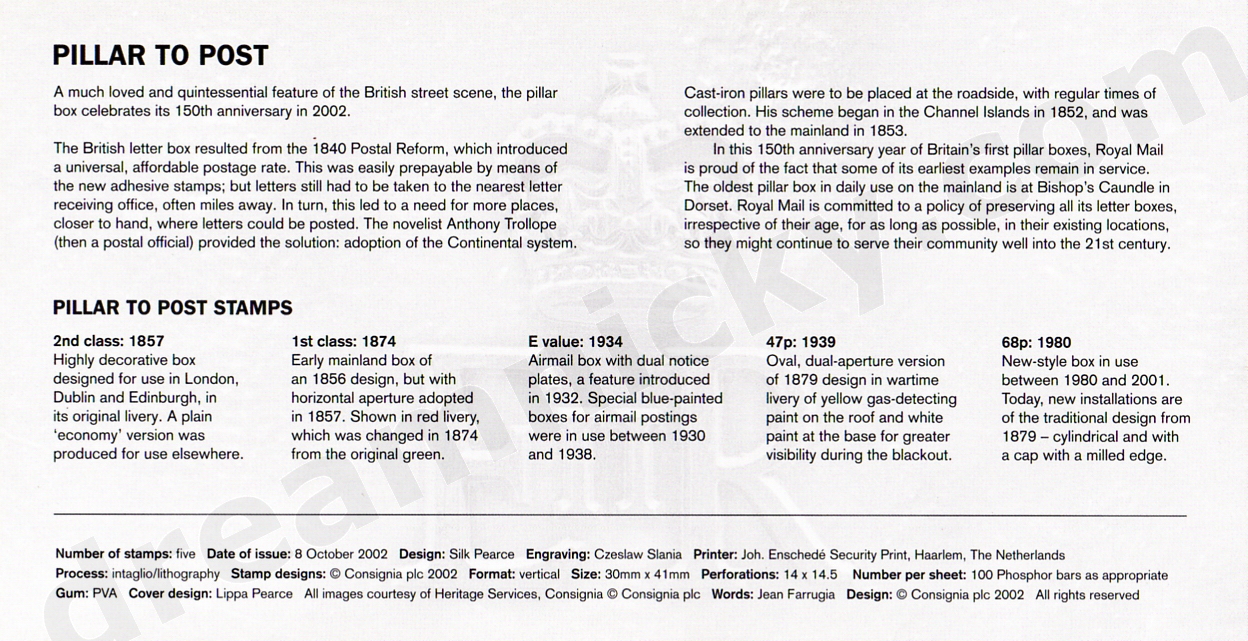
PILLAR TO POST STAMPS
2nd class: 1857
Highly decorative box designed for use in London, Dublin and Edinburgh, in its original livery. A plain 'economy' version was produced for use elsewhere.
1st class: 1874
Early mainland box of an 1856 design, but with horizontal aperture adopted in 1857. Shown in red livery, which was changed in 1874 from the original green.
E value: 1934
Airmail box with dual notice plates, a feature introduced in 1932. Special blue-painted boxes for airmail postings were in use between 1930 and 1938.
47p: 1939
Oval, dual-aperture version of 1879 design in wartime livery of yellow gas-detecting paint on the roof and white paint at the base for greater visibility during the blackout.
68p: 1980
New-style box in use between 1980 and 2001. Today, new installations are of the traditional design from 1879 – cylindrical and with a cap with a milled edge.
|
Technical Details
Number of stamps: five
Date of issue: 8 October 2002
Design: Silk Pearce
Engraving: Czeslaw Slania
Printer: Joh. Enschedé Security Print, Haarlem, The Netherlands
Process: intaglio/lithography
Stamp designs: © Consignia plc 2002
Format: vertical
Size: 30mm × 41mm
Perforations: 14 × 14.5
Number per sheet: 100
Phosphor bars as appropriate
Gum: PVA
Cover design: Lippa Pearce
All images courtesy of Heritage Services, Consignia © Consignia plc
Words: Jean Farrugia
Design: © Consignia plc 2002
All rights reserved
Search this site for first day covers:
|


 United Kingdom
 Back to Page 6
 Jump
Jump