|
|
Chek Jawa
A Natural Haven
One of Singapore's richest ecosystems can be found in Chek Jawa. Tucked away at the eastern tip of Pulau Ubin, Chek Jawa is a natural haven that boasts a unique collection of six distinct habitats. It has coastal hill forest, mangrove, rocky shore, sandflats, coral rubble and seagrass lagoon. Chek Jawa is unique as all these different habitats are clustered in an area that is one square kilometre in size but rich in the biodiversity.
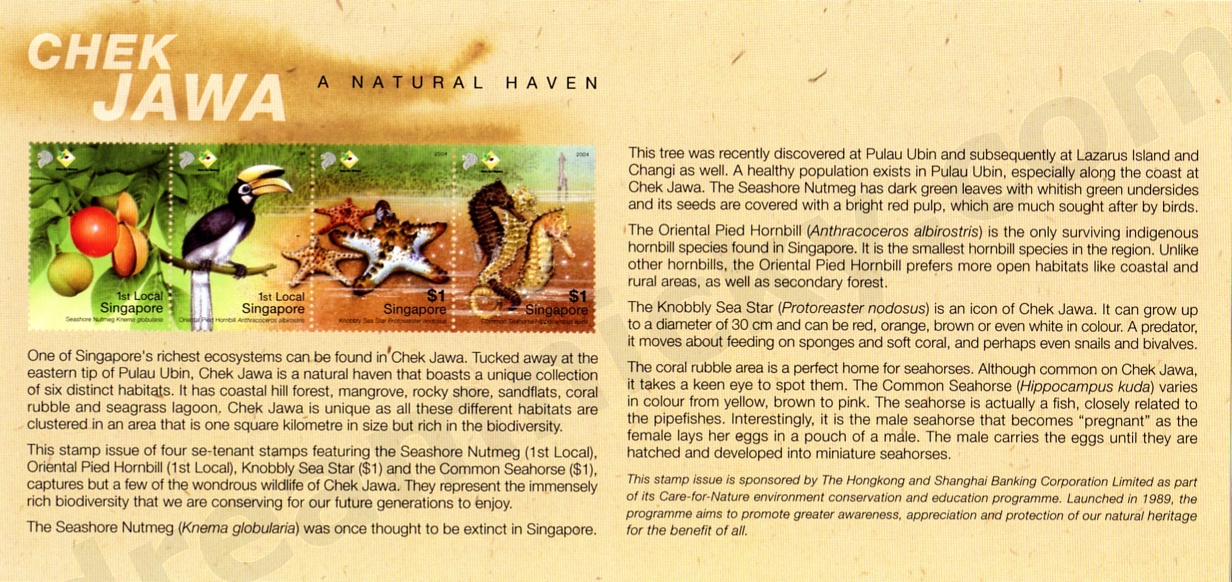
This stamp issue of four se-tenant stamps featuring the Seashore Nutmeg (1st Local), Oriental Pied Hornbill (1st Local), Knobbly Sea Star ($1) and the Common Seahorse ($1), captures but a few of the wondrous wildlife of Chek Jawa. They represent the immensely rich biodiversity that we are conserving for our future generations to enjoy.
The Seahorse Nutmeg (Knema globularia) was once thought to be extinct in Singapore. This tree was recently discovered at Pulau Ubin and subsequently at Lazarus Island and Changi as well. A healthy population exists in Pulau Ubin, especially along the coast at Chek Jawa. The Seashore Nutmeg has dark green leaves with whitish green undersides and its seeds are covered with a bright red pulp, which are much sought after by birds.
The Oriental Pied Hornbill (Anthracoceros albirostris) is the only surviving indigenous hornbill species found in Singapore. It is the smallest hornbill species in the region. Unlike other hornbills, the Oriental Pied Hornbill prefers more open habitats like coastal and rural areas, as well as secondary forest.
The Knobbly Sea Star (Protoreaster nodosus) is an icon of Chek Jawa. It can grow up to a diameter of 30 cm and can be red, orange, brown or even white in colour. A predator, it moves about feeding on sponges and soft coral, and perhaps even snails and bivalves.
The coral rubble area is a perfect home for seahorses. Although common on Chek Jawa, it takes a keen eye to spot them. The Common Seahorse (Hippocampus kuda) varies in colour from yellow, brown to pink. The seahorse is actually a fish, closely related to the pipefishes. Interestingly, it is the male seahorse that becomes "pregnant" as the female lays her eggs in a pouch of a male. The male carries the eggs until they are hatched and developed into miniature seahorses.
This stamp issue is sponsored by The Hongkong and Shanghai Banking Corporation Limited as part of its Care-for-Nature environment conservation and education programme. Launched in 1989, the programme aims to promote greater awareness, appreciation and protection of our natural heritage for the benefit of all.
|
Technical Details
Date of Issue: 20 October 2004
Denominations: Se-tenant strip of four stamps. 1st Local × 2 designs, $1 × 2 designs
Stamp Size: 30mm × 40mm
Self-adhesive Stamp Booklet Size: 70mm × 90mm
Perforation: 14
Paper: Unwatermarked
Printing Process: Offset Lithography
Printer: Southern Colour Print
Sheet Content: 20 stamps per sheet
Designer: Eng Siak Loy
Search this site for first day covers:
|


 Singapore
 Back to Page 2
 Jump
Jump