|
|
Night Creatures
Wildlife of the Dark
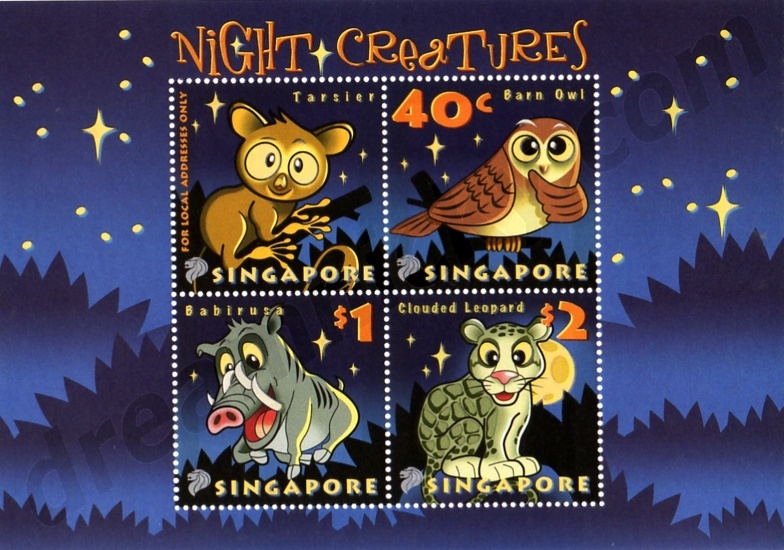
When the sun goes down and night darkness covers the landscape, a set of animals doing the 'night shift' is beginning to rouse from their resting spot and become active. These nocturnal creatures take advantage of the cooler temperature and the cover of darkness to forage for food or hunt for prey. In this stamp issue, four of these night creatures are beautifully illustrated in cartoon-style.
The adorable Tarsier, Tarsius spectrum, is spotted in the first stamp "For Local Addresses Only". Tarsiers are mammals that live in the rainforests of Indonesia and the Philippines. Their tarsus bones in the legs are specially modified for leaping, hence their name 'tarsier'. They spend almost their entire life in trees, using the long tail to balance when they leap and pads on their digits for better grip. Their sense are sharpened with enormous eyes and large ears.
The Barn Owl, Tyto alba, found in almost every continent except Antarctica, is featured in the 40 cents stamp. Striking in appearance, the Barn Owl has no ear tufts and its eyes and beak are framed by a heart-shaped facial ruff of white and rimmed with tan. Unlike other owls, the Barn owl makes a loud, rasping hiss, rather than a hoot. A nocturnal predator, the Barn Owl uses its acute sense of hearing to locate its prey and its silent flight prevents its victim from hearing its approach.
Illustrated on the $1 stamp is the extraordinary Babirusa, Babyrousa Babyrussa. It is a large pig-like animal found in Sulawesi, Indonesia. The oddest feature of the Babirusa is the bizarre tusks of the adult male. The upper canines of the male grow through the root of the upper jaw and arch backward while the lower canines protrude from the sides of the lower jaw. The tusks remind one of the antlers of a deer and giving rise to its name that literally means 'pig deer' in Malay.
The Clouded Leopard, Neofelis nebulosa, as seen on the $2 stamp, is named after their beautiful cloud-like markings, which have blackish edges and paler centres. The markings help the clouded leopard to blend in with the shifting shadows of the forest canopy. Elusive by nature and largely nocturnal, these cats are found primarily in dense remote evergreen forests, mangrove swamps and grassland of South East Asia, southern China, Taiwan, Borneo, Nepal and India.
|
Technical Details
Date of Issue: 20 March 2003
Denominations: No-value indicator, 40¢, $1 and $2
Stamp size: 36mm × 36mm
Miniature sheet: 135mm × 94mm
Perforation: 13¾ × 13¾
Paper: Unwatermarked
Printing process: Offset lithography (stamps); silk screen for glow in the dark (miniature sheets)
Printer: Joh Enschede Security Printers
Sheet content: 10 stamps
Designer: Wong Wui Kong
Search this site for first day covers:
|


 Singapore
 Back to Page 1
 Jump
Jump